The Mathematica Journal
has a new article showing how to simulate the gaps that appear in the asteroid belt at certain resonance frequencies.
Saturday, January 21, 2012

Tuesday, July 5, 2011
Our house guest for this week
Some friends of ours are enjoying a trip to the West coast this week, and we are keeping their dog for them. Lucy is a cute little miniature poodle. We've never had a dog, always have had cats. This is turning out to be fun and is requring me to get out of bed earlier, which I needed to do anyway! Here are a couple of pictures:


Thursday, June 9, 2011
Satellite Flys Over
Here's a picture of the track made by a satellite as it flew over Fallen Leaf Lake near Lake Tahoe a couple of nights ago. It's very dark there and easy to take star field pictures. This was made with a Canon Rebel XSi, 30 second exposure, f/4.0, and then post-processed in The GIMP.
I later identified this satellite as SEASAT 1, using the very nice freeware program "Orbitron." SEASAT was launched in 1978 to do ocean research, and failed about 100 days later.
I later identified this satellite as SEASAT 1, using the very nice freeware program "Orbitron." SEASAT was launched in 1978 to do ocean research, and failed about 100 days later.

Sunday, February 13, 2011
Physics - Can we test inflationary expansion of the early universe?
Here's an interesting article about a paper in Phys Rev Letters outlining a plan for testing the inflationary scenario. Have a look:
Physics - Can we test inflationary expansion of the early universe?
Physics - Can we test inflationary expansion of the early universe?
Tuesday, February 9, 2010
A picture of Mars
Mars is near opposition now, which means that it's fairly close. So I tried taking some pictures, using my 8" Celestron ttelescope and ToUCam 840 Webcam. Here's my first result - not too great, but shows the polar cap:


Saturday, December 12, 2009
The Hardwoods with Furniture!
Movers came today and put the furniture back upstairs - it looks great on the new floor. Here are a few shots:


And here is a great movie showing an auroral display:
Saturday, December 5, 2009
Snow in Houston + New Hardwoods


Second item: SNOW IN HOUSTON !!!
This is the earliest it has ever snowed here...

Look carefully for the snow (click to get larger image):

This is Mt. Everest with a starry background (the Astronomy Picture of the Day):
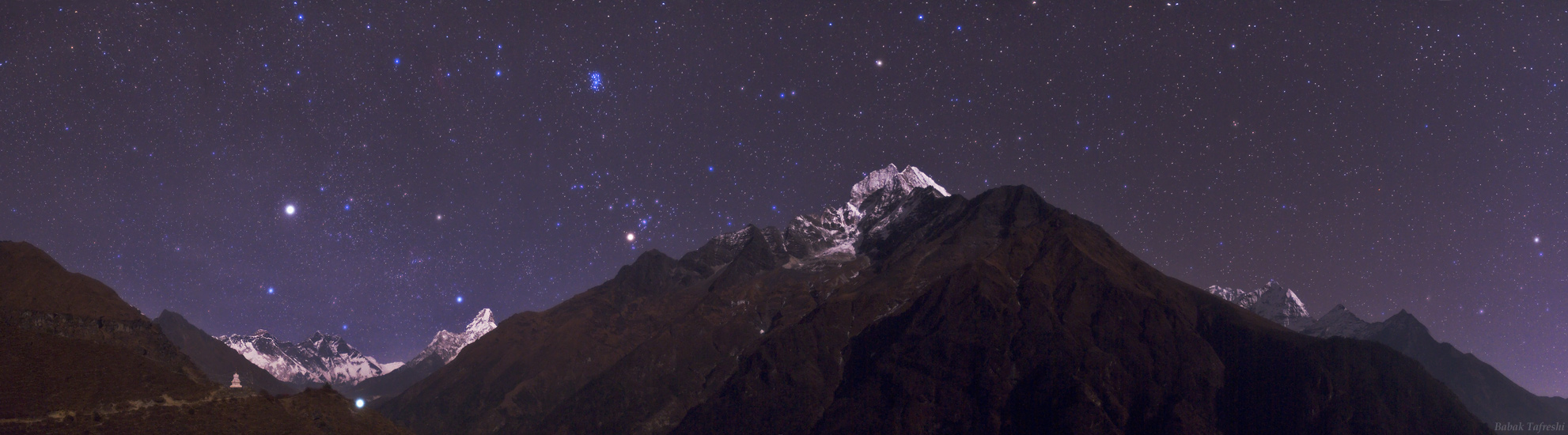
And here is the view from my car showing a police car blocking the road while a crew shovels sand onto the road. (What a joke!)

Finally, Christmas is coming -

Thursday, January 1, 2009
Book Searching
“dilogarithms”
Solar Cycle 24
Below I've tried to post math in a style that would work on WordPress - well, it does not work here. I don't know how to do math on BlogSpot!
Look at the document source to see how to strike out text, how to use different colors, and how to link to URLs with snapshot preview and how to link to URLs without snapshot preview.
There is a command which is ignored by pdflatex and which defines where to cut the post in the version displayed on the main page
Wednesday, December 24, 2008

Tuesday, November 4, 2008
Good luck, America!
We'll need it. We just elected a man with little experience, a shady past, Socialistic ideas, and promises to tax us hard-working people out of existence. He threatens to bankrupt the coal industry.
I believe he thinks himself to be much wiser than he really is.
Have a great four years,
Tom
I believe he thinks himself to be much wiser than he really is.
Have a great four years,
Tom
Monday, October 6, 2008
Testing Math
All I want to do here is to see if I can enter an equation and have it look OK:
∫ dx cos(x) = sin(x) + C
∑k=1,...n 1/k ≈ log(n) + γ + 1/(2n)
Well, it's not great but it could be worse.
For hints on how to do this (as well as more info on HTML in general) see here and here.
Here's some stuff I copied from another page, to keep around for reference. This obviously needs work - I need to learn some more HTML!!
∫ dx cos(x) = sin(x) + C
∑k=1,...n 1/k ≈ log(n) + γ + 1/(2n)
Well, it's not great but it could be worse.
For hints on how to do this (as well as more info on HTML in general) see here and here.
Here's some stuff I copied from another page, to keep around for reference. This obviously needs work - I need to learn some more HTML!!
√(a2 + b2)
√(a2 + b2)
square root of ( a^2 + b^2 )
| lim n→∞ | an |
| lim n→∞ | an |
{ limit n -> infinity } a_n
| ∞ ∑ n = 0 | an |
| ∞ ∑ n = 0 | an |
{ sum from n = 0 to infinity } a_n
| ∆u = Δu = | n ∑ i = 1 | ∂2u/∂xi2 |
| ∆u = Δu = | n ∑ i = 1 | ∂2u/∂xi2 |
Laplacian of u = Delta u = { sum from i = 1 to n } d^2u / dx_i^2
| b ∫ a | f(x) dx |
| b ∫ a | f(x) dx |
{ integral from a to b } f(x) dx
Saturday, September 27, 2008
Electricity is Good
All,
We've been without power since Ike, until a few hours ago. That made a little over two weeks.
The worst part was that we never had a real clue when it might come back. Centerpoint Energy published very vague maps about when certain zip codes would have their power restored. Going by zip code is too coarse; most of ours had power a week ago, but not us!
More later,
Tom
We've been without power since Ike, until a few hours ago. That made a little over two weeks.
The worst part was that we never had a real clue when it might come back. Centerpoint Energy published very vague maps about when certain zip codes would have their power restored. Going by zip code is too coarse; most of ours had power a week ago, but not us!
More later,
Tom
Friday, September 12, 2008
Ike approaches

The latest forecast for Hurricane Ike is discussed in an interesting note at
Jeff Master's blog. He notes that the storm is very much stronger than the indicated intensity of 2, due to its vast size. The storm surge will rival that of Carla.
He notes that a good measure of the total strength of a hurricane is its Integrated Kinetic Energy (IKE!). For Ike, this is around 149 Terajoules. For comparison, Katrina was rated at 122 Terajoules.
Sadly, I've seen several news reports about people refusing to leave Galveston Island and other low-lying areas. They face almost certain death. In fact, the police are asking them to put identifying marks on themselves, so they can be more easily identified when they are found. I can't believe it.
Time to get back to work!
Tom
Monday, September 8, 2008
This doesn't look too promising
I'm talking about Hurricane Ike; here are the latest computer models, which have it going pretty close to us in Houston:

On a more positive note, the LHC is still scheduled to start up on Wednesday. Also, experimenters at Fermilab have discovered a new type of baryon, the Ωb, which contains two strange quarks (along with a single bottom quark). (In contrast, the proton is composed of two up quarks and one down.) It mass is about 6 times that of the proton, just as expected from lattice gauge theory calculations.

On a more positive note, the LHC is still scheduled to start up on Wednesday. Also, experimenters at Fermilab have discovered a new type of baryon, the Ωb, which contains two strange quarks (along with a single bottom quark). (In contrast, the proton is composed of two up quarks and one down.) It mass is about 6 times that of the proton, just as expected from lattice gauge theory calculations.
Monday, September 1, 2008
A rap song about the LHC
I mentioned the coming startup of the LHC in my last post. Well, there's a great rap song on YouTube by alpinekat that explains what it is going to do! Check it out here: Large Hadron Rap
Enjoy!
Tom
Enjoy!
Tom
Saturday, August 30, 2008
Here Come Gustav and the LHC!
Bought lots of water and batteries and gasoline today as Gustav makes its way somewhere toward the Gulf Coast. Most models show it hitting Louisiana, but what it does after that may bring a lot of rain to Houston. Houston floods very easily, being flat as a pancake.
A great site for following tropical weather is here. I've really gotten into it, watching the updated computer models as they change over time.
I guess one of the biggest stories in science these days is the eminent startup of the Large Hadron Collider (LHC) at CERN in Switzerland. This accelerator will reach energies high enough to see the remaining particle needed to make the Standard Model make sense, the Higgs boson, with a mass of maybe around 250 GeV. I'll have much more to say about this later. For now, you can follow the countdown to LHC startup at this link. It is scheduled to begin running on September 10. Of course, months or years of data collection will be required before any new physics can be seen with confidence.
Have a great week,
Tom
A great site for following tropical weather is here. I've really gotten into it, watching the updated computer models as they change over time.
I guess one of the biggest stories in science these days is the eminent startup of the Large Hadron Collider (LHC) at CERN in Switzerland. This accelerator will reach energies high enough to see the remaining particle needed to make the Standard Model make sense, the Higgs boson, with a mass of maybe around 250 GeV. I'll have much more to say about this later. For now, you can follow the countdown to LHC startup at this link. It is scheduled to begin running on September 10. Of course, months or years of data collection will be required before any new physics can be seen with confidence.
Have a great week,
Tom
Monday, August 18, 2008
Here We Go

I'm not quite sure why I started this blog - we'll just see where it goes from here. For now, here's a picture of our cat, Zeke:
I'm a (geo)physicist, and I'm sure a lot of this blog will consist of my thoughts on, and links to, current research in physics and cosmology.
That's all for now,
Tom
Subscribe to:
Posts (Atom)